






Receive for Free - Discover & Explore eNewsletter monthly with advance notice of special offers, packages, and insider savings from 10% - 30% off Best Available Rates at selected hotels. 
history
Discover Inn on Boltwood, located within the picturesque Pioneer Valley in Western Massachusetts.
In 1925, just under an acre of land on the corner of Spring Street and Boltwood Avenue in Amherst, Massachusetts was purchased as the future site for a country-style inn in the picturesque region known as the Pioneer Valley. The December issue of Amherst Graduates’ Quarterly announced, “an inn for Amherst is finally on the map.”
Inn on Boltwood is a Colonial Revival-style inn that sits adjacent to the Amherst College campus in Amherst, Massachusetts. The inn was a homegrown project championed by alumni of the prestigious Amherst College, an institution founded in 1821. The Alumni Committee of Amherst College began its plans in 1910 to provide the growing New England town with comfortable, modern lodging. The Alumni Committee at the time thought that the beauty of the Pioneer Valley and welcoming atmosphere of Amherst College was diminished by the lack of suitable hospitality in the town. Lead proprietor Ernest Whitcomb Miller also suggested that a modest, but excellent, inn could become an attractive summer destination for automobile tourists as the state highway was built between Boston and the Berkshires. Suitable to the small town’s reputation, a new hotel, the committee promised, would meet New England sensibilities. “The house will aim to be thoroughly quiet and comfortable without display or luxury,” the committee wrote, and provide guests “an excellent table.”
With funding realized by the sale of stocks in the newly created Amherst Inn Company, the alumni committee purchased a plot of land near the Amherst, Massachusetts commons. A Boston-based architecture firm, Putnam and Cox, had previously designed buildings around the town and campus, including the Amherst College president’s house. It was a natural choice to continue this relationship. Architect Allen Cox took care to design the three-story, cement-wash brick structure in harmony with the neighboring fraternity houses, even designing a new common garden courtyard. In turn, the fraternity houses allowed the builders, Casper Ranger Construction Company, to store construction materials on their lawns. This close relationship with the town and college would sustain the historic hotel over its century of operation.
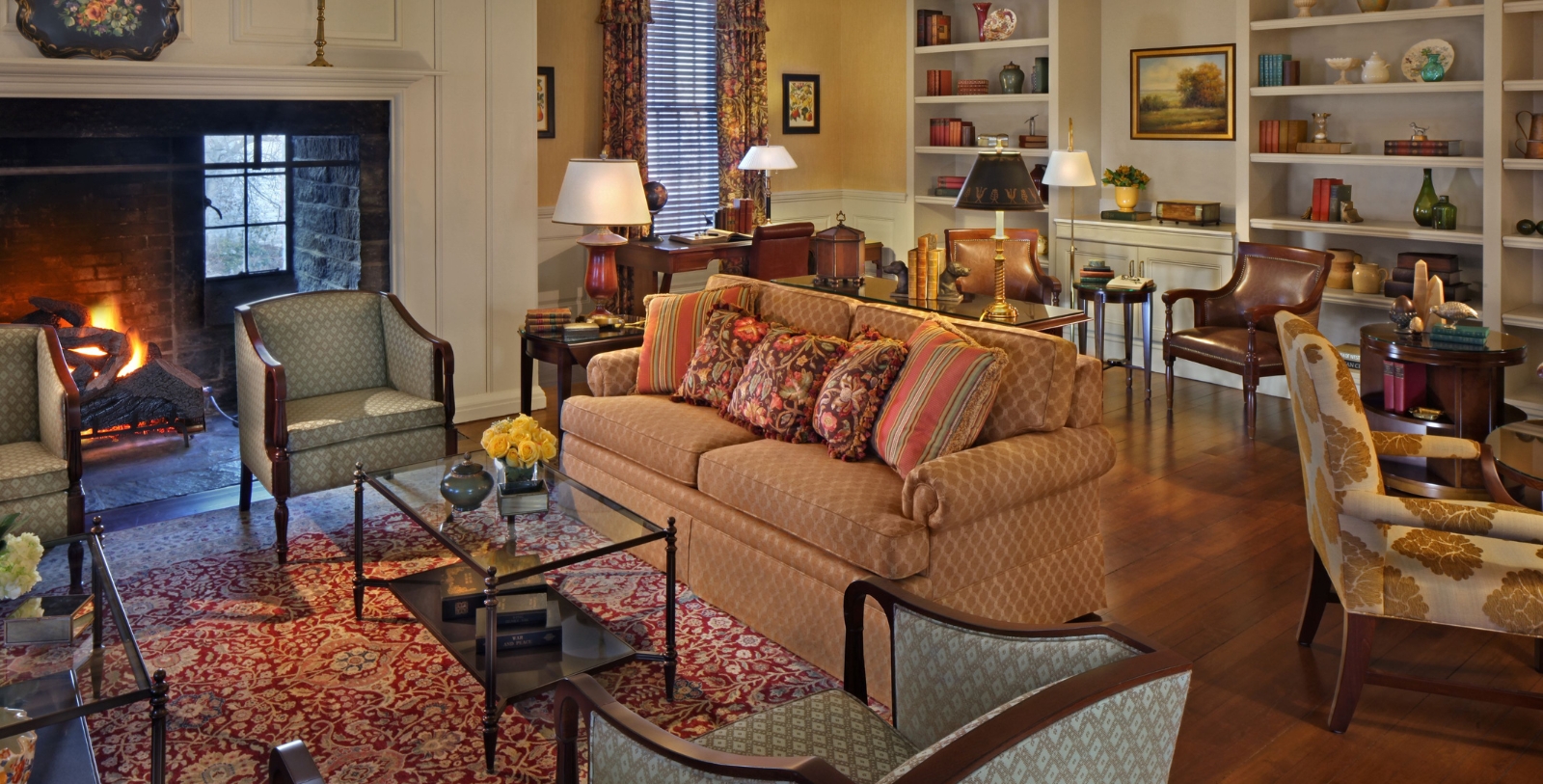
The final Colonial Revival structure had 70 guestrooms, 25 staff rooms, 40 private baths, a main dining room, three private dining rooms, and a polished breakfast porch. The completed inn, then-named The Lord Jeffery Inn, opened to its primary stakeholders on June 3, 1926, and introduced itself to the eager public three days later at a large dinner dance with music provided by an Amherst College glee club. The symbol of the inn’s hospitality became the large fireplace in the lobby around which lodgers and guests could enjoy a good book, a relaxing drink, or a round of song. People soon took advantage of this gathering spot. Achieving its goal of providing a space to socialize in Amherst, the new inn was able to host five simultaneous dinners in an evening and accommodate between 150 and 200 people for special events. The spacious inn frequently hosted faculty parties and musical evenings. Following the wishes of Board of Trustee George Plimpton, the inn housed and exhibited Plimpton’s collection of French and Indian War documents for the public (the collection was later transferred to the college archives in the 1970s). College fraternal organizations including Psi Upsilon took the opportunity to dine at the inn and practice the social customs expected of university men. Visiting professors, including Robert Frost and Shirley Graham Du Bois, took up longer residences in the inn. Robert Frost resided at the inn for several weeks each fall and spring between 1949 and 1963. There he met with students and faculty and held public readings. His corner room on the first floor with a private gate to the garden is still intact.
Other notable events unfolded with the inn as a backdrop. During World War II, the inn hosted a dinner during which Amherst College presented papers to graduates of the Navy training station. When the War Department Civilian Protection School began operating at Amherst College in 1942, the program’s first students lived at the inn while completing civil defense courses. One visit by Hubert Humphrey in 1970 especially drew attention. Student protests cut short his formal speech at the University of Massachusetts, Amherst, prompting the former Vice President to deliver brief remarks to a small gathering inside the inn. In 1979, during his first trip to the United States, the 14th Dalai Lama held a press conference in the lobby after lecturing at Amherst College. Just as important as these high‑profile moments, however, were the informal, everyday ties to Amherst life, such as the regular bartending classes the inn advertised for students.
Throughout the second half of the 20th century, the picturesque New England inn evolved alongside both Amherst College and Amherst proper. When Amherst College welcomed its first coeducational class in 1975 (about 65 women entered the 300 student freshmen class), a housing shortage meant that between 20 and 25 lucky upperclassmen were assigned rooms at the inn. Under the leadership of Joslow Associates in 1986, the inn decided to embrace its original 1926 New England charm. The effort led to the removal of mid-century décor and the concerted preservation of original architectural elements. As a Colonial Revival building, Inn on Boltwood has been recognized as a Historic Asset of the Commonwealth of Massachusetts. In 2012, a major renovation modernized the inn while preserving its historic charm, culminating in the name change to Inn on Boltwood in 2019. Inn on Boltwood continues to exhibit its place in the fabric of Amherst through its support of local institutions, commitment to sustainability, and hearthside hospitality.
-
About the Architecture +
Architect Allen Cox co-founded the Boston-based architecture firm Putnam and Cox in 1902. Cox earned his degree from the College of Architecture at the Massachusetts Institute of Technology before traveling to Paris to further his studies at the École des Beaux-Arts. The Parisian Beaux Arts training emphasized Greek, Roman, Baroque, and Renaissance Revival techniques. Returning to the United States at the height of American Colonial Revival architecture, Cox went on to design many buildings in Massachusetts’ Pioneer Valley, including buildings for Mount Holyoke College and the Jones Library in Amherst proper. Other works by Putnam and Cox include the American Unitarian Association Building and the Copley Theatre in Boston.
In Amherst, Cox was tasked with designing a New England country inn that shirked “the white-tiled formality of the city hotel as well as the haphazard makeshifts of the enlarged boarding-house.” Completed in 1926, the inn featured 70 small guestrooms, 25 staff bedrooms, running water, large social spaces, and 40 private baths. Amherst’s inn served a new, traveling middle class that valued modern comfort and social rituals. A central brick fireplace encouraged socializing in the main lobby, while the public and private dining rooms facilitated entertainment. In fact, it was possible to host five small dinners at the same time in the original inn. Great care was taken to promote cohesion between the inn, the town, and Amherst College. The design even incorporated a new shared courtyard between the neighboring buildings. Cox also designed buildings along Hitchcock Road in the town as well as seven fraternity houses and the president’s house at Amherst College. The Casper Ranger Construction Company of Holyoke, Massachusetts was contracted to build many of Cox’s designs. As the decades passed, the inn was renovated to reflect changing hospitality standards. Most significantly, larger rooms with ensuite baths became the norm. The enclosure of fireplaces, open galleries, and sun porches were also major alterations to the inn’s original floorplan. Under the leadership of Joslow Associates in 1986, the inn decided to embrace its original 1926 New England charm. The concerted preservation effort led to the removal of mid-century décor. 1920s elements such as the baseboards and chair rails were preserved.
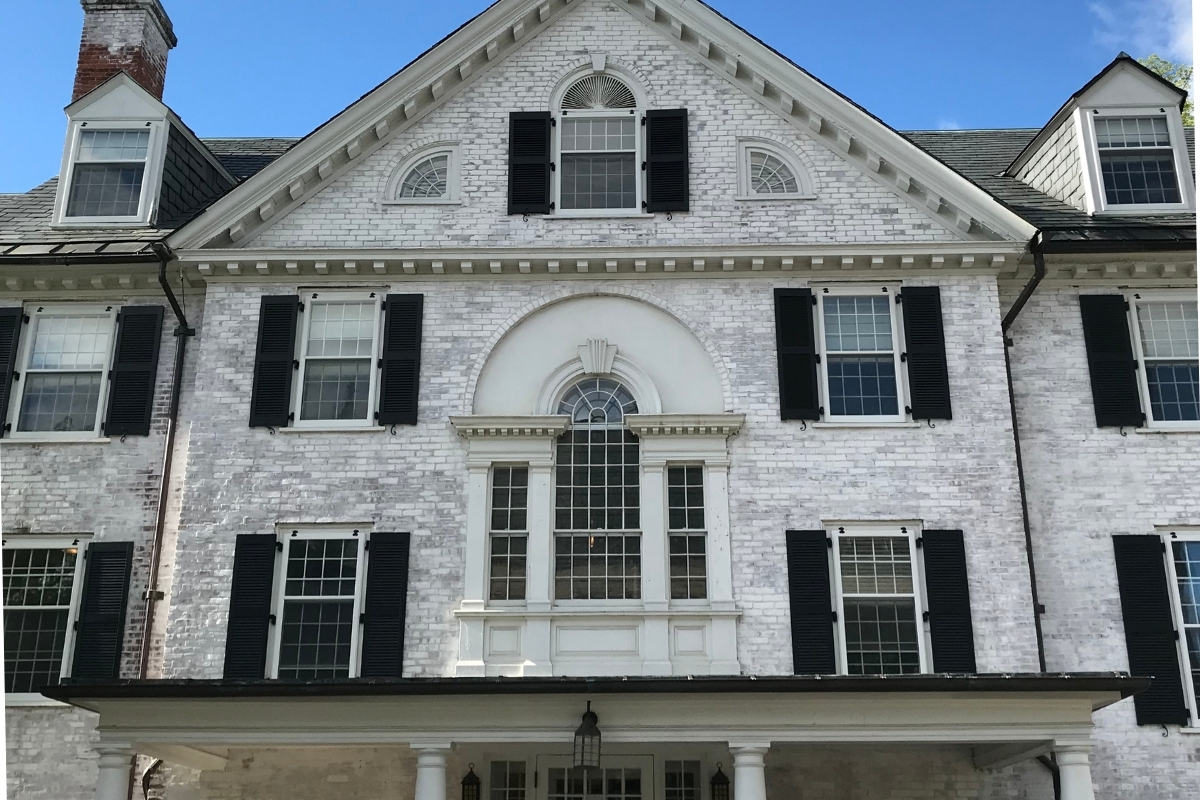
As a Colonial Revival structure, Inn on Boltwood is recognized as a Historic Asset of the Commonwealth of Massachusetts. The building’s typical Colonial Revival features include exterior louvered shutters and a block-modillion wood cornice. The brick façade displays an elegant Palladian window in the center with an arched pediment window above. The inn’s side-gabled roof has both dormers and chimneys and was originally made from black slate. The loggias and wrapped porches are not traditional Colonial Revival elements. These features reflect style preferences in the original design and later building alterations.
Colonial Revival-style architecture became popular in the United States in the 1870s during the centennial of the American Revolution. Celebrations about 18th-century life encouraged millions of people across the country to “revive” a version of the American past through everyday buildings. Architects first looked to incorporate the design principles of colonial English and Dutch homes. This gave way to Georgian Revival and Federal Revival-style architecture, which echoed the country’s formative years. Colonial Revival-style architecture does not replicate original Colonial-era designs. Instead, architects blend many elements and preferences into a single composition. Designs adapt layouts to reflect evolving technologies, customs, and climates. Colonial Revival-style buildings are therefore typically larger and more robust-looking than their earlier counterparts. Colonial Revival architecture became perhaps the most widely used building form in the entire United States, reaching the height of popularity in the Gilded Age and persisting until the 1940s. Many buildings constructed with Colonial Revival-style from this era are historical landmarks. Architects today still construct residential buildings and commercial complexes using Colonial Revival architecture.
-
About the Location +
The fertile landscape of the Connecticut River Valley was formed around 10,000 years ago as glaciers receded across the Berkshire Mountains to the west and the rocky central Massachusetts ridges to the east. The riverways became known as Kwinitekw and supported generations of Algonquin-speaking peoples who created successful trade routes between Canada and the southeastern coast. By the 17th century, Connecticut River Valley groups included the Mahicans, Nipmucs, Agawams, Nonotucks, and other Pocumtuck peoples. War between European colonists and the indigenous people broke out in 1675, affecting life across all of New England. In 1691 Massachusetts Bay Colony and Plymouth Colony officially organized Massachusetts, incorporating the westernmost part of the territory. By the early 1700s, the region became predominantly determined by British, and later, American, landowners.
In 1759 the district of Hadley, Massachusetts was incorporated into a new town named for Lord Jeffery Amherst, commander in chief of the British Army. Lord Amherst achieved recognition after his successful military campaigns on behalf of British North America during the Seven Years’ War. Throughout the 19th century, the farming and mill towns surrounding Amherst benefited from southern cotton production and early industrialization. The region was especially well connected to New York City, the Great Lakes, and Boston. As farming and industry both moved to the Midwest by the mid-20th century, the area again became forested and is now primarily known for its picturesque New England seasons. Marketing campaigns promoted heritage tourism and automobile travel to the charming colonial-era Massachusetts towns by nicknaming the region “Pioneer Valley.” The region is also known for its five distinctive universities: Amherst College, Hampshire College, Mount Holyoke College, Smith College, and the University of Massachusetts, Amherst. The Five College Consortium evolved between the 1910s and 1970s as the area’s institutions shared resources to support the growing number of individuals seeking higher education. Present day Amherst has around 30,000 permanent residents and welcomes another 30,000 university students to the local colleges each year.
Inn on Boltwood is centrally located on the corner of Boltwood Avenue and Spring Street adjacent to the Amherst College campus in Amherst proper. The entire street was once known as part of “the Broadway” and later as “Maple Street” and “Maple Avenue.” In March, 1919, “Maple Avenue” became “Boltwood Avenue.” The street is named for Amherst resident Lucius Manlius Boltwood, a 19th century historian. The Boltwood family had been prominent landowners and business owners in Amherst since the mid-1800s. The most well-known of Amherst’s residents was poet Emily Dickinson. In fact, Emily Dickinson’s paternal grandfather, Samuel Dickinson, was one of the founders of Amherst College and Inn on Boltwood was constructed on land once partially owned by the Dickinson family.
-
Famous Historic Guests +
Robert Frost, Pulizter Prize-winning American poet and United States Poet Laureate.
Archibald MacLeish, American writer and the ninth Librarian of Congress.
Shirley Graham Du Bois, American-Ghanaian writer, composer, and activist noted for her Pan-African perspective.